Note and Note Again and Again Note and Note Again and Again Clipart
 Every school year I start out talking about the work of two smashing literacy educators – Kylene Beers and Robert Probst. What they have shared has changed my life as an educator.
In my belatedly August post, I laid out my plan for reading instruction this yr. A month in, I would like to focus in on the wonderful reading strategy developed past Kylene and Bob – Notice and Note – and talk virtually how I use it in my classroom. It has transformed the way I approach reading pedagogy, and I hope this post will inspire yous to have a look at it equally well.
Let's begin with the nuts. Observe and Note: Strategies for Close Reading, for those who have not read the book, provides readers with signposts – tools to help detect moves fabricated past authors that serve as indicators something is happening. The strategies have a strong enquiry base of operations.
Beers and Probst identify half dozen signposts associated with fiction and literature. They've as well written a book most non-fiction which has its own unique signposts – but what I write here will focus on the half dozen for fiction and some ways I use them in my classroom, from guided practice to independent utilise through reading response and course word.
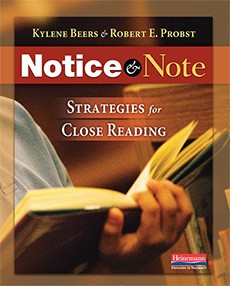 The 6 signposts are:
- Dissimilarity and Contradiction,
- Aha Moments,
- Tough Questions,
- Words of the Wiser,
- Again and Again, and
- Retentiveness Moments.
All signposts assist students in looking at different elements of a story (e.g., conflict, theme) and in making predictions or an inference. Students in my class first acquire to simply identify signposts then they motility to awarding. We exercise this through using many different forms of text including brusk stories, picture books, video shorts and novel excerpts.
Part of our form culture
Each year in 7th grade I get to introduce the signposts to a new group of students. To practise this I stick very strictly to the text examples supplied by the authors in their amazing book. There are Facebook groups out at that place and a lot of resource other teachers have crafted, but those are not a replacement for reading this education masterpiece. The instance texts (see Companion Resources) are completely attainable for all students and serve as crystal articulate examples of how the signposts work. (See these teacher notes from the book site about signposts in Walk 2 Moons.)
This year I have students from grades 7 to 9. Some are in their 3rd year of using the signposts with me so we are becoming creative in finding new examples. The online ELA customs is super helpful, recommending unlike novels and motion picture books that can serve as great examples to share with students equally they continue to build their signposting skills.
 Using the amazingly creepy first affiliate of Nightbooks by J.A. White to illustrate Contrast and Contradiction, Tough Questions and Aha Moments served as a great example of multiple signposts, an awesome mentor text for descriptive writing, and a terrific entry for our First Chapter Friday read-alouds (run across here & here) that had two students reading it that very day (one with the book; another with the audio).
The haunting story of survival at a Residential School in Canada in the tween movie book I Am Not a Number provided my students with opportunities to learn about the tragedy of residential schools as well as exercise signposts and reflection effectually theme and conflict with both Tough Questions and Again and Over again throughout the story.
In the cease, we utilise a collection of short stories, picture books and film to practise the work. I stress to my students it is not nearly how many things we discover but about the thinking that is inspired by our noticing. Our assessments focus on the literary work – the signposts support u.s., but I don't assess the pupil's signpost reflections themselves.
Today we watched Disney's The Lion King, not some computer-generated version simply the original 1994 multiple award winner. We laughed, we visited, we noticed and noted, and we discussed. The motion picture is full of signposts. We will take our findings, organized as mind maps and then utilise the signposts and answers to the anchor questions to arts and crafts responses around conflict and theme.
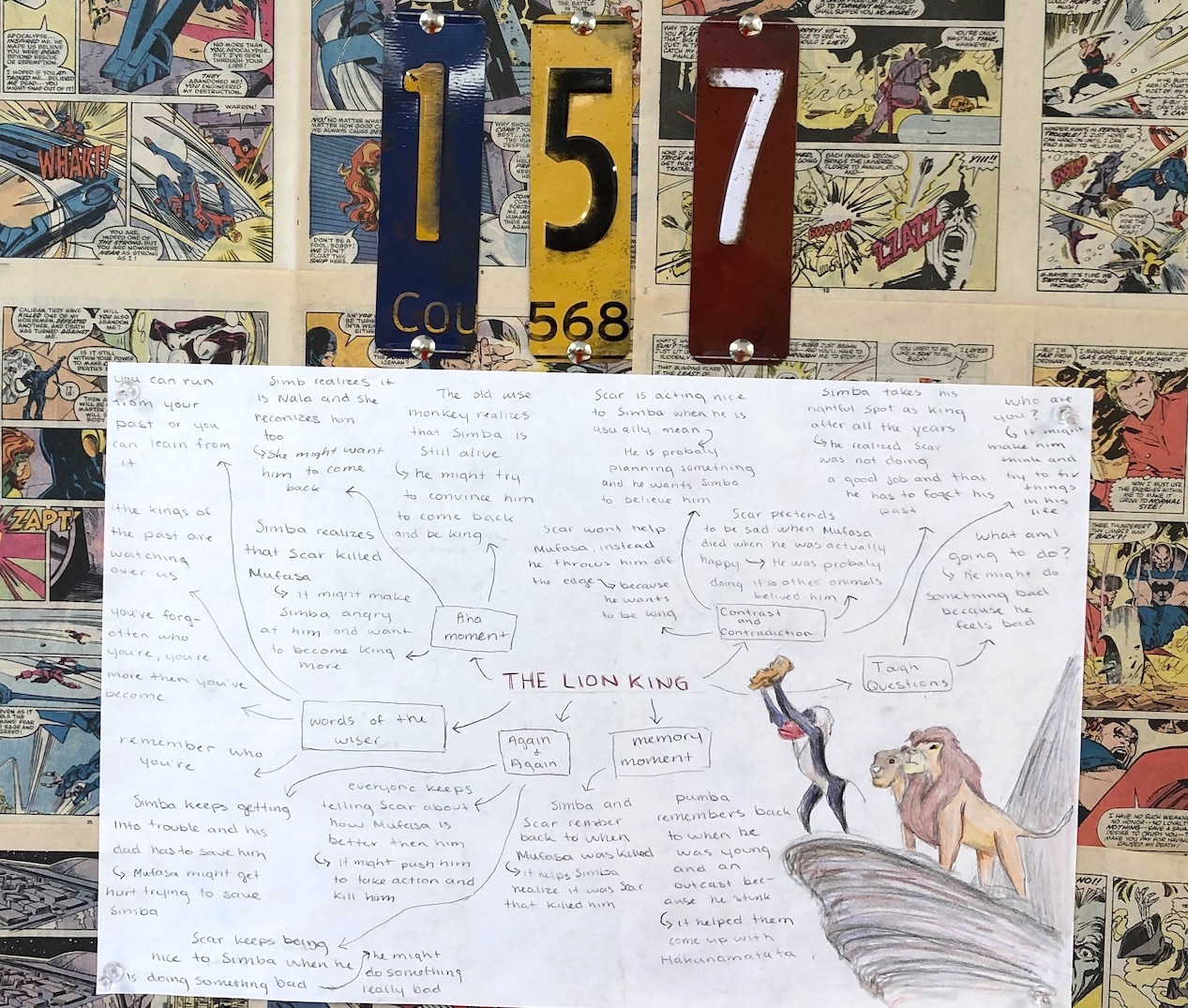
N&N student work on our classroom door [bigger]
Detect & Note is about community
I love Notice & Note. I love the fact that it helps my students go closer readers, but I beloved even more the sense of community it builds. We read texts together, we share what we find, and we build our understanding as a class. At that place are not lists to be relied on, no Teachers Pay Teachers nonsense that steals from those who take gifted us with this treasure while lining the pockets of those skilled in devising clip art and designing worksheets.
There are no tests, no scavenger hunts, and no defined number of signposts that students must find and study on. Not everything nosotros practise needs to be broken downwardly and forced into some kind of assessment box. There is dazzler in the thinking; there is joy in the piece of work.
The Detect & Note I dearest was created to help students form connections, to take discussion, to admission a text that may not have been meaningful to them before. Notice and Annotation and the signposts are a key to a door that when unlocked gives students access to many more insightful, fifty-fifty life-changing books and stories that are out there waiting in the world.
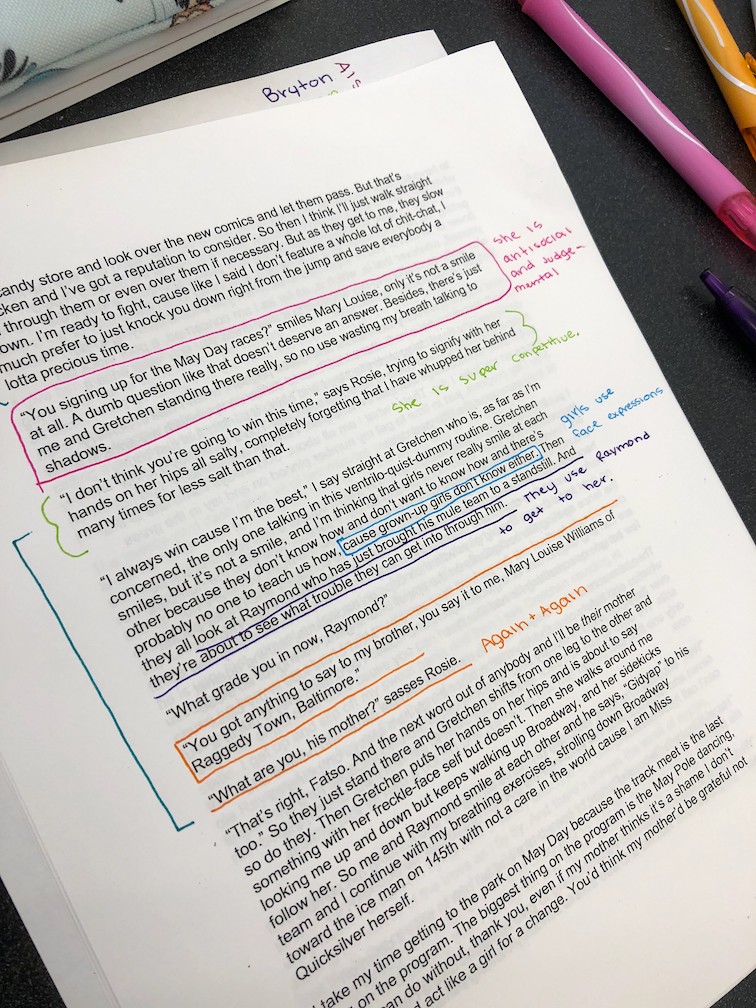
from the 1999 curt story "Raymond'due south Run" past Toni Bambara (click)
There is aught that brings me more joy than the gasps equally nosotros read a text in class and a signpost is noticed and a pupil begins to write in their Notebook. Sometimes I will intermission to ask why – to be in that moment with my class. It is a moment in time, not an interruption to our reading but an add-on to it.
Just as rigor does not reside in the barbell simply in the act of lifting it, rigor in reading is non an attribute of a text but rather of a reader'south beliefs – engaged, observant, responsive, questioning, analytical. The close reading strategies…will help you cultivate those critical reading habits to make your students more circumspect, thoughtful, independent readers." — Beers & Probst, The Heinemann Blog, "What Are the Notice and Notation Signposts?"
The signposts and Observe & Notation likewise seem to level the playing field of literacy. Students who struggle in the traditional piece of work of reflection are oftentimes the ones to notice signposts offset. Perhaps it's because it is a tangible thing they tin can hold on to – a discovery that guides them toward the less tangible, idea-driven parts.
I don't know for certain, but I do know that as a instructor I am grateful for these close reading tools, and the chance they give us to piece of work together as we get better readers and in plough writers. I will be eternally grateful for these tools and the educators that created them. I'yard likewise grateful for the many teachers in our professional person networks who keep coming up with new and dissimilar ways to help our students practice them (#noticeandnote).
If you have any questions nearly Detect & Note or demand some help reaching out to teachers already doing the piece of work, please leave a comment or go in touch on @mrbgilson. Notice & Note builds a community of readers and thinkers that extends far beyond our classroom walls, and that community includes not only our students but ourselves.
CREDIT: Feature image of half-dozen signposts – Tricia Barvia
fergusongeoplegatill1940.blogspot.com
Source: https://www.middleweb.com/41277/a-teachers-love-letter-to-notice-and-note/
0 Response to "Note and Note Again and Again Note and Note Again and Again Clipart"
Post a Comment