Kato 106-6193 Maxi-i Double Stack 5 Unit Set Ttx / Cai Containers Product Review
Posted by Neville C. Wilson on 15th Jun 2021
Ane of the nigh popular styles of railcar in contemporary utilise in Northward America, currently mainstays on American track, double stack well cars that are used to transport intermodal containers are some of the most sought-after model railroad products sold today.
With their releases of articulated well car sets, intermodal containers, container handling vehicles, Volvo semi tractor cabs with a container and chassis, G Tractors with a container and chassis, and the UNITRAM freight depot sets, which tin be used for either car, or intermodal terminal facilities, Kato USA markets the well-nigh complete intermodal operations organization available in Due north-Scale.
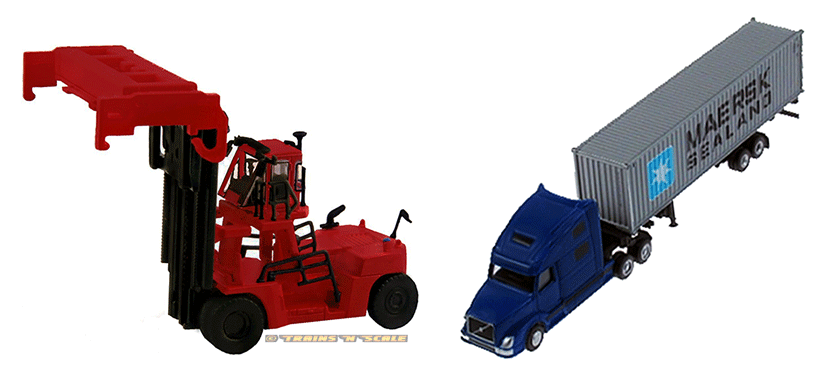
Kato 31-631 Container Handler and 31-617 Volvo Tractor, Container Chassis, and forty Foot Maersk Container
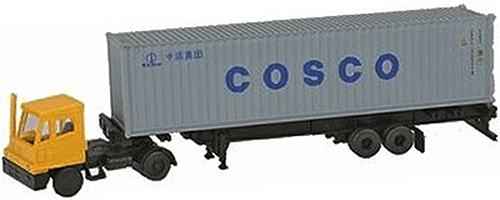
Kato 31-621 Thousand Tractor, Container Chassis, and 40 Foot Cosco Container
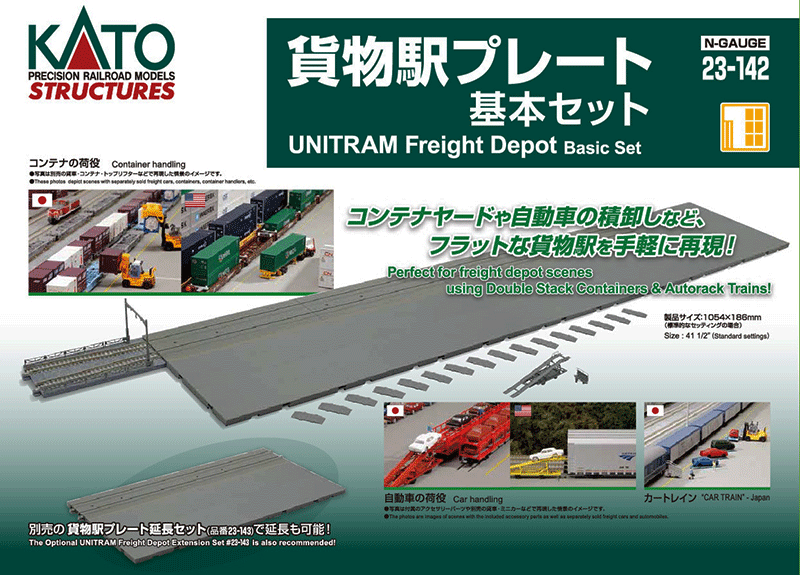
Kato 23-142 UNITRAM Freight Depot Basic Set
Over the years, at that place have been multiple releases of the extremely popular Kato MAXI series intermodal well cars.
With detail stock numbers, road names, and road numbers, the Kato United states of america website has 2 online pages that are dedicated to all of the N-Calibration Gunderson MAXI-I and MAXI-4 sets that have been released thus far.
Comprised of item number 106-6175, a TTX with route number DTTX 724792, speed-line lettering logos, and navy blue CSX Intermodal containers, item number 106-6176, a TTX with road number DTTX 766519, mod ruby logos, and UMAX containers, item number 106-6177, a Burlington Northern Santa Fe with road number BNSF 253791, circular logos, and green HUB Group containers, detail number 106-6178, a Burlington Northern Santa Iron with route number BNSF 253411, swoosh logos, and blood-red HUB Group containers, and item numbers 106-6179 and 106-6180, Pacer Stacktrain units with route numbers BRAN 6020 and BRAN 6066 and Pacer Stacktrain containers, the latest run of Kato North-Scale Gunderson MAXI IV three-unit stack car sets began arriving on dealers shelves in August 2020.
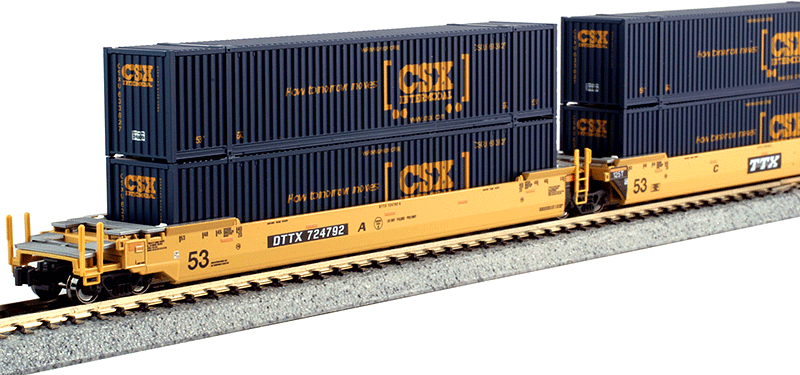
Kato 106-6175 Gunderson MAXI-Iv Double Stack Car 3-Unit of measurement Set TTX DTTX 724792 with CSX Containers
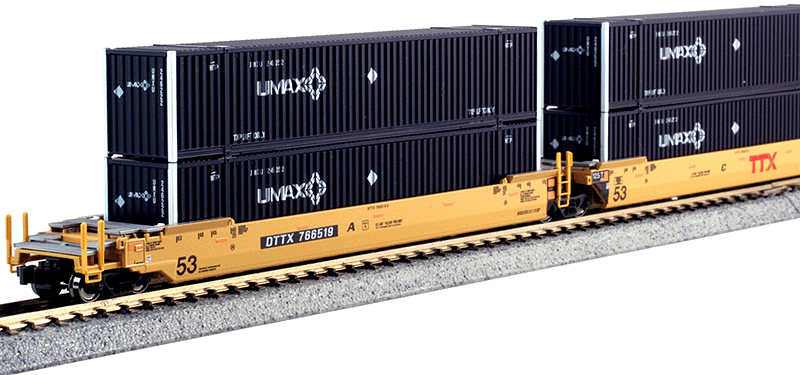
Kato 106-6176 Gunderson MAXI-IV Double Stack Car 3-Unit Set TTX DTTX 766519 with UMAX Containers
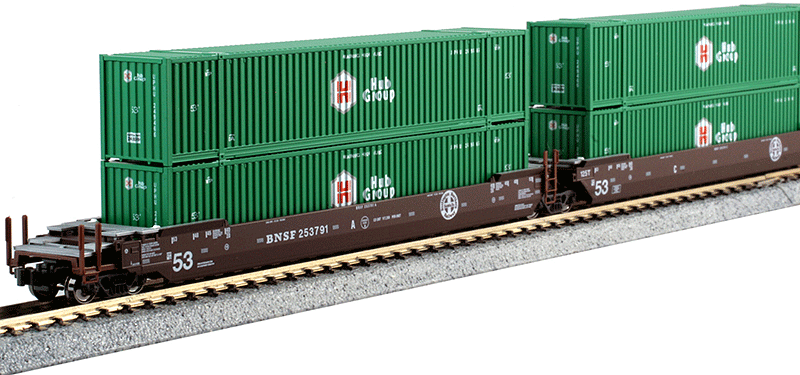
Kato 106-6177 Gunderson MAXI-IV Double Stack Car three-Unit of measurement Gear up BNSF 253791 with HUB Group Containers
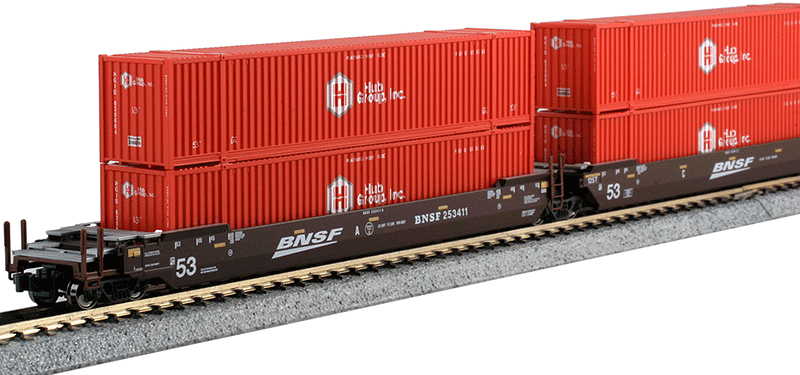
Kato 106-6178 Gunderson MAXI-IV Double Stack Car 3-Unit of measurement Set up BNSF 253411 with HUB Grouping Containers
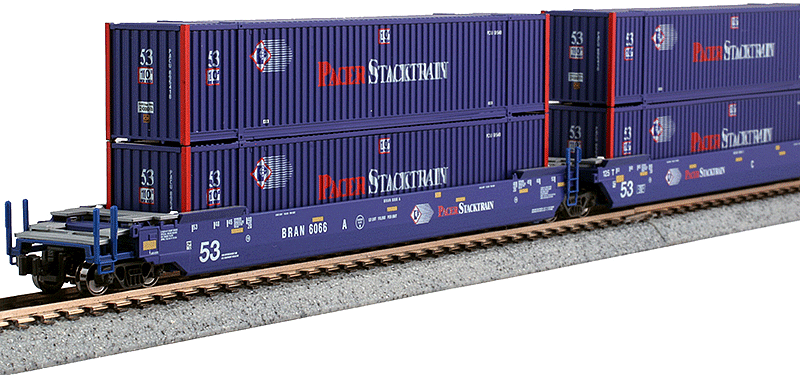
Kato 106-6180 Gunderson MAXI-Iv Double Stack Automobile 3-Unit of measurement Ready Pacer Stacktrain BRAN 6066 with Containers
As well re-released, comprised of item numbers 106-6194 and 106-6195, Burlington Northern Santa Iron units with road numbers BNSF 238615 and BNSF 238693, swoosh logos, and magenta ONE (Sea Network Express) containers, item numbers 106-6196 and 106-6197, TTX units with road numbers DTTX 759324 and DTTX 759350, modernistic red logos, and light greyness ONE (Ocean Network Express) containers, and item numbers 106-6198 and 106-6199, MAERSK units with route numbers MAEX 100029 and MAEX 100043 and MAERSK containers, the most contempo run Gunderson MAXI-I five-unit of measurement sets made their debut in March (MAERSK) and May (BNSF and TTX) 2021.
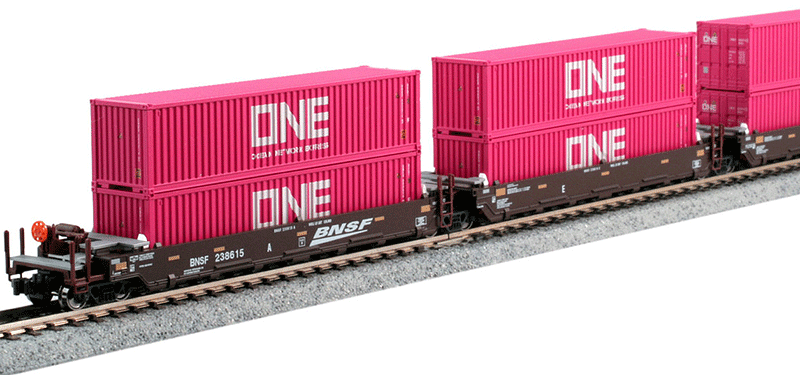
Kato 106-6194 Gunderson MAXI-I Double Stack Car v-Unit Set BNSF Swoosh 238615 with Ane Containers
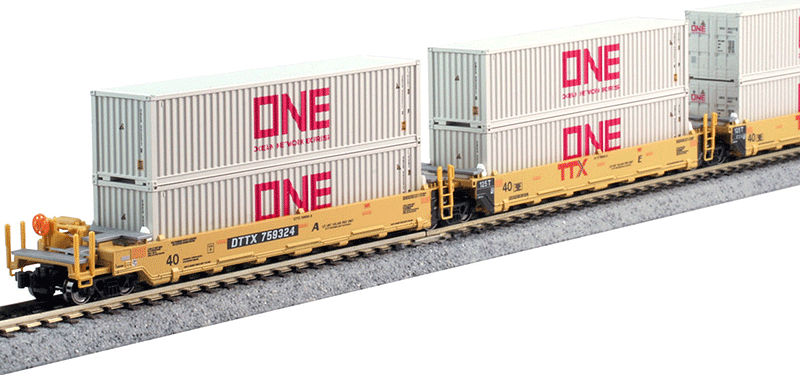
Kato 106-6196 Gunderson MAXI-I Double Stack Auto 5-Unit Fix TTX DTTX 759324 with ONE Containers
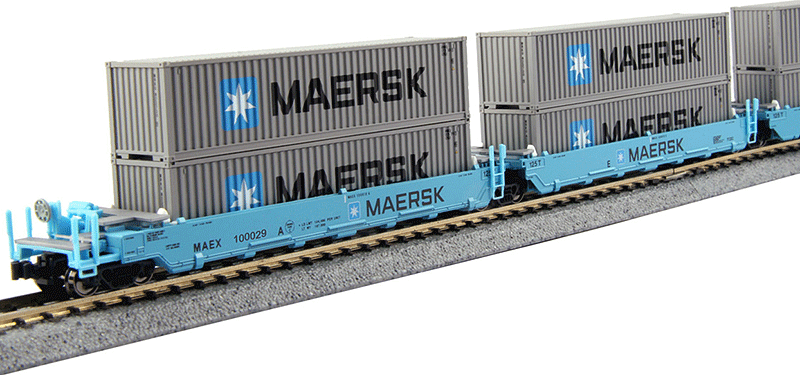
Kato 106-6198 Gunderson MAXI-I Double Stack Car 5-Unit Set Maersk MAEX 100029 with Containers
The MSRP for i of the newest run MAXI-Iv sets is $125.00, which is twelve pct higher than the previous MSRP of $110.00 a set.
With a $150.00 MSRP, the pricing on the MAXI-I sets remains unchanged.
Like their predecessors, the recently released models have crisply decorated heavier material steel compound plastic bodies, molded in color plastic brake wheels, hand-grabs, inner well bracing, steps, and walkways, Kato knuckle couplers with stop user installed trip pins, and metal wheels that are fitted to steel axles.
Unlike the separately attached injection molded plastic hand-grabs with open come across-through centers that are found on the Northward-Scale Atlas rebuilt intermodal well cars, the centers of the 8 plastic hand-grabs plant on the ends of the A and B end cars that are shipped with the Kato MAXI I and IV sets are partially filled.
With a flexible clear plastic encompass placed over a pocketed gray colored Styrofoam car storage tray that does non retain each car every bit tightly (i.e., a positive attribute) every bit some of the earlier versions of packaging did, the sets are shipped in a green cardboard box with 3 window openings that partially reveal three of the individual units and six of the containers.
Bearing different window arrangements, the latest run of Kato MAXI-I and MAXI IV models are shipped in the same sized box.
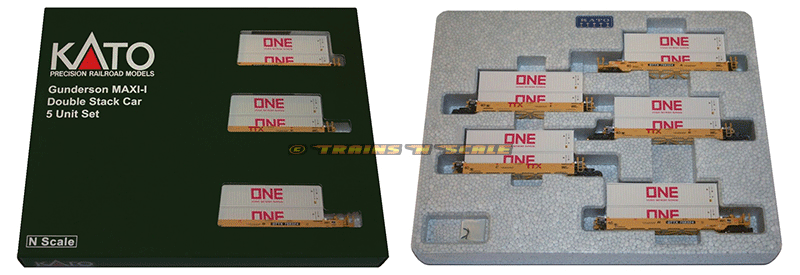
Kato 106-6196 Gunderson MAXI-I Double Stack Motorcar 5-Unit of measurement Set up TTX DTTX 759324 with ONE Containers and Inner and Outer Packaging
I of the big advantages of containerized goods transport is that once they are filled, the contents is not handled again until a container reaches its final destination.
With load begetting points located on their ends, forty pes long containers are the standard unit length.
While both container heights are eight human foot wide, in contrast to standard (which are also called depression-cube or LC) containers, which accept a maximum height of 8 foot six inches, high-cube (which are also called hi-cube or HC) models stand nine human foot half dozen inches tall.
Although 20 foot long containers cannot be stacked upon a longer length container, with their excess length hanging equally over each end of the smaller container that they have been perched upon, longer length containers are designed with centrally located load bearing points that are positioned forty foot apart.
Eventually condign the Marine and Track Equipment Division (MRED) of FMC in 1973, FMC Corporation acquired the Gunderson Bros. Engineering Corporation in 1965.
A articulation venture with Greenbrier saw the 1984 introduction of the five-unit Gunderson Twin-Stack® articulated well cars with bulkheads.
In 1985,
While a forty-five human foot long aircraft container could exist loaded on acme of a forty footer that was placed in the well, designed to provide support for stacked containers, which at the time, lacked the rotating Inter-box Connectors (IBC's) that are currently used to secure the boxes when they were moved, stowed, or in transit, the bulkheads prevented the top loading of forty-eight and fifty-three footers.
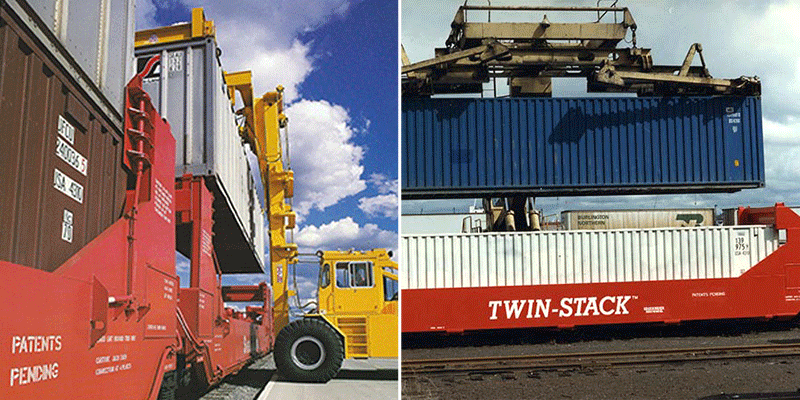
Greenbrier Gunderson Twin-Stack ® Promotional Images Courtesy of The Greenbrier Companies
The advent of forty-viii foot long domestic intermodal containers saw the need for a new articulated well automobile design that eliminated the problematic bulkheads.
In 1989, Greenbrier Gunderson introduced the 5-unit of measurement MAXI-Stack® III, which could conform 20 to forty-eight pes long containers in their wells, with xl to fifty-three footers stacked on superlative.
Once they could be legally transported on the bulk of Us highways, 50-three foot long containers became a standard for domestic North American cartage, which resulted in the development of the ubiquitous MAXI-Stack® IV.
Although roadway regulations vary by state, with previously established superlative and width limits that have for the most part remained in place (i.e., except for the domestic 50-three human foot long loftier cube containers which are 9 foot six inches high and 8 foot six inches wide), increases in domestic container load weight and size were derived from the mutual maximum legal length and fully loaded weight of fifty-three foot for semi-tractor trailers.
Due to the size and weight of the fully loaded containers that they were designed to carry, the MAXI-Stack® IV is confined to a three-unit length.

MAXI-Stack® Four Container Loading Examples Diagram Courtesy of The Greenbrier Companies
On a product hiatus throughout the 1990s, attributable to a huge rise in international ISO container transportation and increased demands from railroads, with a large order initially placed by the BNSF Railway, the production of revised MAXI-Stack® I sets resumed in 2000.
According to an April 16, 2020 press release, due to the economic impacts of COVID-19, The Greenbrier Companies, Inc. had suspended the production of new railcars at its flagship Greenbrier Gunderson manufacturing facility in
Run continuously for nearly twenty-five years, attributed to corporate cost cutting measures, weak customer demand, and waning intermodal rail loadings which were exacerbated by the effects of the COVID-nineteen outbreak, during the previous week, Greenbrier Gunderson ended the production of its double stack car line.
The at present defunct Deluxe Innovations previously released manufacturing plant assembled North-Scale models of the Twin Stack®, MAXI-Stack® III, and MAXI-Stack® Four (i.e., an earlier production version) articulated well cars.
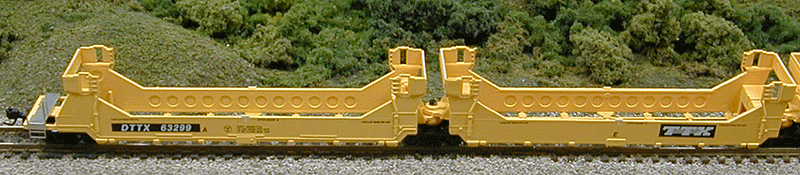
Deluxe Innovations Twin-Stack® TTX DTTX 63299 "A" End and "E" Mid Cars
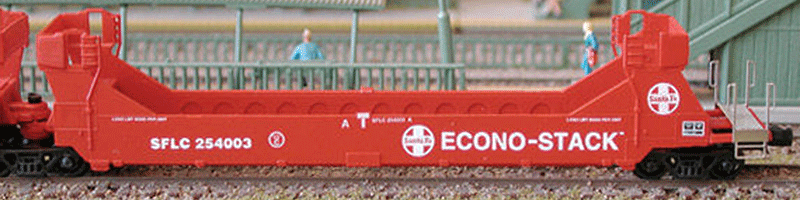
Palatial Innovations Twin-Stack® Santa Fe Econo-Stack SFLC 254003 "A"Stop Car
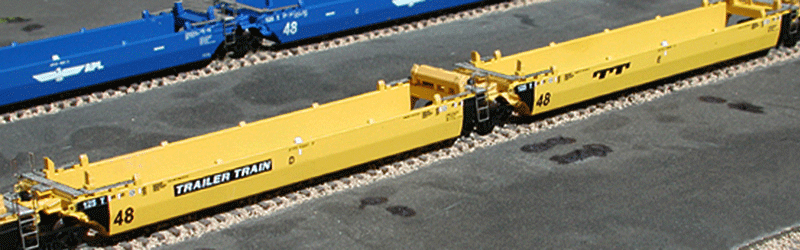
Palatial Innovations MAXI-Stack® III American President Lines (APL) and Trailer Train "D" and "E" Mid Cars

Deluxe Innovations MAXI-Stack® IV TTX DTTX 726750 "A" End and "C" Mid Cars
To date, the Kato MAXI I is the only available ready-to-run North-Scale model of the now ubiquitous five-unit Greenbrier Gunderson well car sets.
Providing an optimum balance between tare weight, load chapters, and railcar slack activeness, designed for railroads that transport large numbers of international ISO containers that are used for overseas shipments, with a twoscore to fifty-three foot long container loaded on top, the wells on a MAXI-Stack® I can accommodate a forty footer, or a pair xx footers.

MAXI-Stack® I Container Loading Examples Diagram Courtesy of The Greenbrier Companies
In some parts of
Although the employ of smaller wheel sizes lowers a railway car's carrying capacity, in gild to reduce the vertical clearance needed for railway operation, in
Compared to other types of rolling-stock that are primarily constructed out of steel, even when they are fully loaded, autorack cars have fairly low-cal axle loads.
This is not the case with the Greenbrier Gunderson MAXI series cars, which for load bearing reasons (i.eastward., the bulk of the load weight is borne by the mid-car trucks and wheels) accept trucks with two different load capacities, that are fitted with ii different wheel sizes
Like the epitome car sets, the Kato models have 30-six inch wheels on the coupler equipped seventy-ton end car trucks and thirty-eight inch wheels on the 125-ton mid-car trucks.
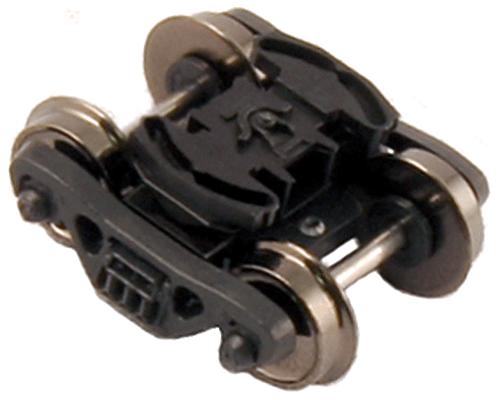
Kato 800112 125-Ton MAXI-Stack® Mid-Car Truck without Coupler
When they were checked with a Micro-Trains® Line top approximate, the truck mounted Kato magnetic knuckle couplers were found to be at the correct top.
Using an NMRA Standards Approximate, the wheel-sets were found to exist properly gauged.
As the wheels have depression-profile flanges, when they were run on Atlas Lawmaking 55 track, no tracking problems were noticed.
Bearing the letters A through E, at that place is a specific society in which the MAXI-I machine bodies must be assembled.
The A and B units are end cars and the C through Due east units are mid-cars
Starting with the A unit and ending with the B unit, the middle cars are attached in descending club (i.e., E, D, and C).
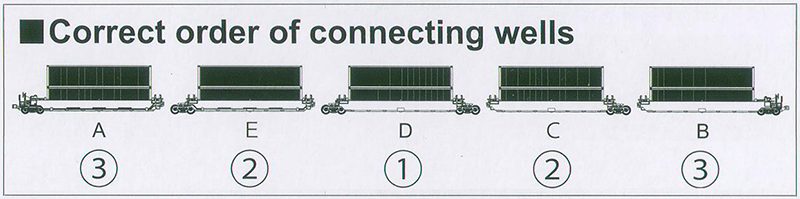
Kato Gunderson MAXI-I Double Stack Car Connection Guild Diagram CourtesyKato USA
Joined in the aforementioned way and bearing the aforementioned lettering scheme every bit the MAXI-I cars, the MAXI-4 mid car has the alphabetic character C and the end cars bear the letters A and B.
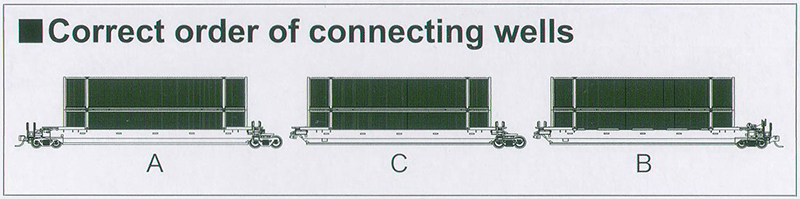
Kato Gunderson MAXI-IV Double Stack Car Connectedness Club Diagram CourtesyKato USA
Absent on the MAXI-Iv cars, like the paradigm, which has circular depressions on the inner faces of the well sides, in that location are twelve circular cut-outs molded into each side of the injection molded plastic interior support frames of the Kato MAXI-I wells.
Given that the weight of articulated car sets was never factored into the National Model Railroad Association's NMRA RP-xx.one recommended practice guidelines for rolling-stock weight, it is somewhat difficult to make up one's mind if the Kato car sets are too light, too heavy, or just right.
With an individual car body length of 4.1875 inches, a fully assembled length of 20.0 inches without the couplers, a weight of 2.ii ounces empty, and four.4 ounces with a full complement of Kato twoscore foot containers, with a pair of trucks attached, each of the five units that a MAXI-I set is comprised of weighs 0.4 of an ounce empty and i.0 ounce with a pair of mill supplied containers.
On an private unit basis, loaded with a pair of 40-foot containers and fitted with a pair of trucks, each MAXI-I well is 0.15 of an one time lighter than NMRA RP-xx.1 recommended weight of 1.xv ounces.
With individual car body length of 5.125 inches, a fully assembled length of xv.25 inches without the couplers, a weight of 1.8 ounces empty, and 3.6 ounces with a total complement of Kato fifty-three foot containers, with a pair of trucks fastened, each of the iii units that a MAXI-IV set is comprised of weighs 0.vi of an ounce empty and 1.2 ounces with a pair of factory supplied containers.
On an individual unit of measurement basis, loaded with a pair of fifty-3 foot containers and fitted with a pair of trucks, each MAXI-IV well is 0.ten of an once lighter than NMRA RP-20.i recommended weight of 1.30 ounces.
Negligible in both cases, if the minor weight discrepancies are a major concern, cease users tin add some weight to the loaded containers.
Somewhat off, both models have plastic detail parts that are molded in color, rather than painted like the rest of the car body is.
Molded in argent plastic, with a thickness that varies from approximately 0.twenty to 0.28 of an inch, the models' walkways are non encounter-through.
Despite the sets' continued popularity, no aftermarket etched metal hand-grabs and/or walkway item kits are available for either of the Kato models.
As railroads consider multi-unit articulated well auto sets similar the Greenbrier Gunderson MAXI serial models to be a single car, an unabridged consist shares the aforementioned road number.
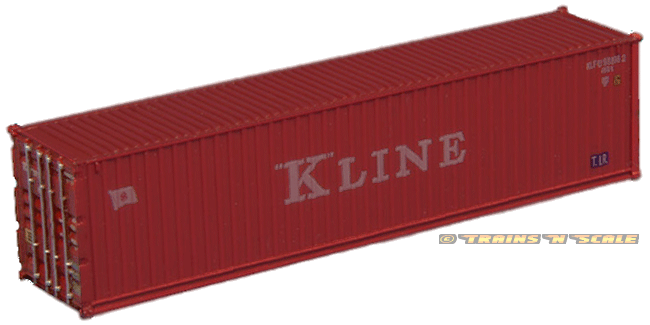
Kato 23-507B 40 Foot Intermodal Container K-Line KLFU 988962
The latest run of MAXI-I sets were shipped with the post-obit forty pes container liveries and series/registration numbers:
Kato Particular Number 106-6194 has ten (magenta) One (Ocean Network Express) ONEU 000014 containers
Kato Detail Number 106-6195 has ten (magenta) Ane (Ocean Network Express) ONEU 000255 containers
Kato Particular Number 106-6196 has 10 (light gray) One (Ocean Network Limited) ONEU 002277 containers
Kato Item Number 106-6197 has ten (light gray) One (Body of water Network Express) ONEU 002289 containers
Kato Item Number 106-6198 has ten Maersk MSKU 585 436 42G1 containers
Kato Detail Number 106-6199 has x Maersk MSKU 620 436 42G1 containers
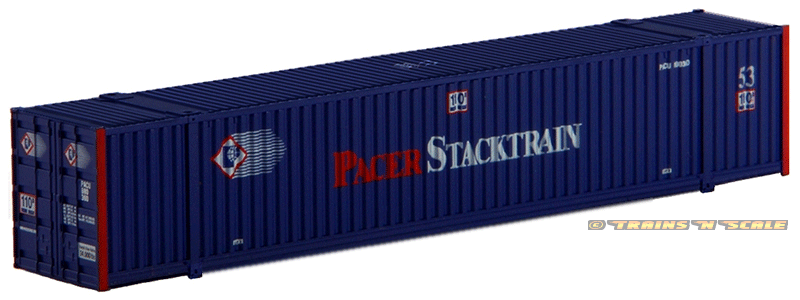
Kato 800546 53 Human foot Intermodal Container Pacer Stacktrain PACU 880360
The latest run of MAXI-Iv sets were shipped with the following fifty-three foot container liveries and serial/registration numbers:
Kato Item Number 106-6175 has half-dozen CSX Intermodal CSXU 633827 containers
Kato Item Number 106-6176 has vi UMAX UMXU 246222 containers
Kato Item Number 106-6177 has six (green) Hub Group UPHU 249466 containers
Kato Detail Number 106-6178 has six (blood-red) Hub Group HGIU 635664 containers
Kato Particular Number 106-6179 has half dozen Pacer Stacktrain PACU 885404 containers
Kato Item Number 106-6180 has half dozen Pacer Stacktrain PACU 895418 containers
Firmly held in place by a mill installed magnet and metal plate when they are stacked or placed in a metal bodied well car, the Kato forty and fifty-three foot containers are completely interchangeable.
The MAXI-I comes with ten forty human foot containers and the MAXI-IV is shipped with half dozen 50-three footers.
With their mill installed metal plate and magnet, both container lengths weigh 0.2 of an ounce.
Despite the installation of the injection molded plastic inner well bracing, the steel compound plastic that was used to fabricate the car bodies allows containers with magnets in their bottoms to remain in identify during car functioning.
In fact, a scene (i.east., fourth dimension frame 1:eighteen to 1:twenty) in a 2012 Kato produced YouTube video shows a single MAXI-IV unit briefly held upside down, with a pair of l-iii foot long containers withal locked in place in the well.
Athearn (twenty and forty footers), Atlas (forty footers), Deluxe Innovations/Trick Valley (twenty and forty footers), Jacksonville Last Company (JTC 20 and 40 footers), Rolland (twenty and forty footers), and Walthers (twoscore footers) containers will fit in a Kato MAXI-I well.
Deluxe Innovations (i.east., a bit snugly), Jacksonville Terminal Company (i.e., although the JTC pins do non line up with the rectangular retention slots that are located in the bottom of the well'southward inner caryatid casting), Micro-Trains® Line, and ScaleTrains 50-three foot containers will fit into a Kato MAXI-Iv well.
Although the pins on Atlas fifty-3 footers will line up with the rectangular retention slots institute in the Maxi-IV wells, the containers' raised door particular prevents them from being used without modifying the ends of the Kato models plastic inner brace casting.
A tad fleck longer than the comparable Kato version, every bit is the case with the aforementioned Atlas 50-iii foot long products, while their pins line up with the slots, the Athearn CIMC l-3 foot containers will not fit into the Maxi-Iv wells without some stop-user alterations.
While not as easy to prepare as the Palatial Innovations cars are, the same on both of the Kato MAXI sets, providing secure and reliable connections, four pins and a pair of lower supports retain adjoining units to a 125-ton truck.
One time y'all become familiar with Kato's unique pattern, linking and unlinking the individual cars becomes less troublesome.
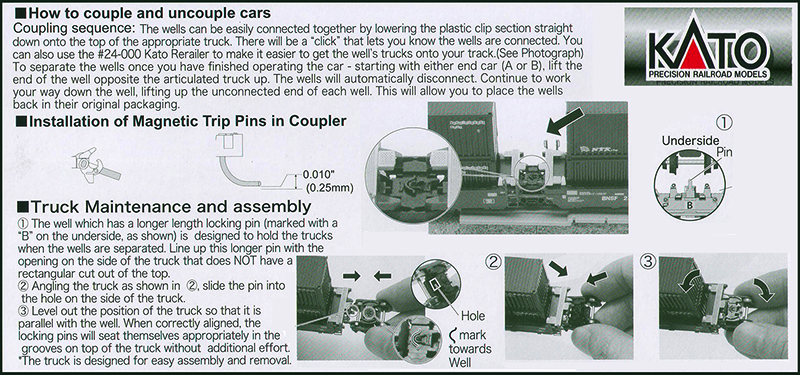
Kato Gunderson MAXI Double Stack Car User Instructions CourtesyKato USA
Forth with the user instructions that are printed on the backs of the cardboard boxes that the sets are packed in, Kato has a instructional YouTube video that explains the unabridged connection process.
Unlike the very finely detailed Palatial Innovations early version MAXI-Iv sets, which were showtime shipped to dealers in Feb 2015, accept end-user installed mud flaps for the A and B car platform ends, run across-through etched stainless steel lift rings and walkways, and a twelve-inch to 14-inch (i.eastward., with the mud flaps attached) minimum operating radius, with their Atlas code 55 track friendly wheels, both of the Kato models negotiate xi-inch radius curves, crossover tracks, and turnouts with ease.

Deluxe Innovations 350101 MAXI-Stack® Iv TTX DTTX 723210
Per prototype railway practices, where lighter pieces of rolling-stock are typically placed toward the rear of a train consist, given their typically light weight, information technology would probably be prudent to identify your empty well car models on the end of a train.
Every bit is case with moves to and from train club layouts, and/or NTRAK, and/or T-TRAK gatherings, somewhat harder to assemble and detach when they are compared to their single unit of measurement counterparts, with their robust detailing (i.east., every bit opposed to many of the competitive intermodal well car models that are produced by other manufacturers), the Kato products are better suited for situations that require frequent handling.
While purists might bewail the fact that Kato chose to use unpainted and somewhat off-color plastic detail parts and well interior support frames, end-car manus grabs with partially filled centers, and thick plastic walkways that are devoid of see-through holes, most buyers will discover that the durably made Kato models make excellent additions to an intermodal car fleet.
View additional articles like this one in the Trains N Scale™ Models and Prototypes Weblog.
fergusongeoplegatill1940.blogspot.com
Source: https://trainsnscale.com/models-and-prototypes-blog/a-quick-look-kato-n-gunderson-maxi-stack-car-review/
0 Response to "Kato 106-6193 Maxi-i Double Stack 5 Unit Set Ttx / Cai Containers Product Review"
Post a Comment